Friday, March 10, 2017

Five for Friday March 10th

I am linking up with Doodle Bugs Teaching for Five for Friday. Thank you for hosting, Kacey!


Hi! I hope you all had a wonderful week.  Quick question- Where is this "spring" I've heard about? Actually, this winter hasn't been as cold as some I remember, but I'm ready for it to be over.  It doesn't look like that's happening, at least this week.  We are actually already hoping for our last snow day on Tuesday if the forecast is right.  That's a teacher's way of turning lemons into lemonade... Our saying should be "If winter gives you snow, turn it into a snow day."  Anyway, this is my spring bulletin board for the hall., which I thought was timed better!

Our next writing unit is our Persuasive Writing.  Jillian Jiggs is a great mentor text to use to introduce a ... messy room.   The kids love to see that somebody else has a room that looks like it was lived in by pigs! 
Here is the video if you aren't familiar with the story.
                                

After we read the story, I like to have the children turn and talk to share why it is important to keep their bedroom clean (so toys don't break, so mom is happy, so you don't lose things, so you don't trip and fall on things) and then transition to why it is important to keep our classroom clean (pretty much the same reasons except you can just substitute in 'so the teacher is happy!').  After this discussion, I write a mentor text with the children to show how we can persuade (or convince or encourage) others to keep the classroom clean using important reasons. (I wasn't even going to share this mentor text I made with the class because of the 'illustrations'  but then I thought you might get a kick out of those ridiculous lips and teeth in the last picture...)    

My kids LOVE to use an ellipsis any chance they get.  Probably because I do, too...  
Writing this persuasive story together gives the children a good idea about how to write to convince someone to do something using reasons- very simply.  This is a good introduction story.  You can always add to and elaborate on the reasons as time goes by.  You could add speech bubbles, extra tips, anything fun like that to give the kids other ideas.  

You can have the children make a book after you model one, or they can make a poster for the classroom and write their favorite reason on the poster. 

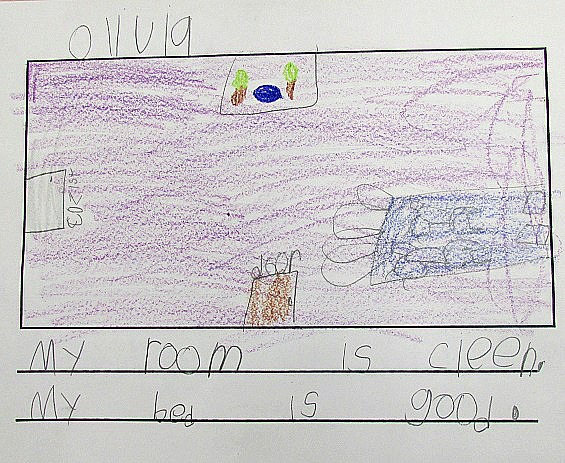
Jillian Jiggs  is fun to use throughout the year in different ways.  In the beginning of the year after we read, we draw and label a map of our own bedroom.   First, I have the children write a sentence focusing on using neat printing, spaces, and hearing all the sounds.   I model "My   room    is   _________."   "My" and "is"  are sight words.  We hear the "r" then the two "oo's" (like they've heard in BOO all last month!) and "m" at the end of the word.  They can choose anything to write at the end- the color of their room, if it's clean or messy, big or small... 

                                                     "My room is clean." (beginning of the year)
This time of the year, I have the children draw and label a map of their bedroom, and then write about their bedroom and why it is special to them:


Another fun thing we do for Persuasive and Opinion Writing is to learn how to spell 'because.'  That's a big word, and the kids are so proud to know it!  We sing a little song:
(BINGO tune)
I know a class who writes opinions,
'Because' tells the reasons-
B-E-C-A-U-S-E
B-E-C-A-U-S-E
B-E-C-A-U-S-E
'Because' tells the reasons.

It's silly- and simple. But it works. You just have to spell BECAUSE a little faster than BINGO to make it fit. I literally make every word fit the BINGO song because that's the tune I can remember.  

Here is our vowel song just in case you don't believe me:

I know a class who knows some letters
Vowels are their name-O
A-E-I-O-U
A-E-I-O-U
A-E-I-O-U
and sometimes even Y, Y, Y.

In the beginning of the year if some children just can't remember how to spell their name, I can make almost every name fit that song, too.

I know a girl with long, brown hair, 
And Mary is her name-O
M-A-R-Y
M-A-R-Y
M-A-R-Y
and Mary is her name-O!

I'm a one-trick pony.  
                                                        
This time of year the children are really starting to take off with reading. They're using their reading strategies and growing each day!  I want to be sure they continue to grow as much as they can at home as well as at school. We don't send homework home with children (thank goodness), but we do send  books home with them to practice reading at home. I wanted to send home some ideas to help parents while they read at home with their children. Reading at home with children is such a huge benefit and important part of a child's reading success, but sometimes we forget that parents don't always know what we're focusing on or looking for as they read with their child. I made this parent note to help with ideas.  I labeled the praise points, "Wonderful," and the questions for parents to ask, "Wondering."


These ideas help parents remember to praise, praise, praise and encourage their child as they read together at home, as well as provide questions to help parents take their child deeper into the text and beyond the text. 

I thought you might like to use it with your students' parents, too.  Just click the picture below if you would like a copy!  Enjoy!


Here are some good graphics you could share with families, as well, to show the benefits of reading with their child each night at home.  This graphic is from Makayla Schenkelberg


This is from Perry Public Schools:


One of my former students, now in 4th grade, who I just love to pieces, stopped by my room like she does every morning.  She dug through her bag because she had something for me, and pulled out this scratched plastic ornament.  I told her how much I loved it, and gave her a hug. When I asked where she got it, and she just shrugged, I sort of knew right then and there it was probably a hot item she'd stolen from some other "World's Best Teacher." I know I should go right down to her teacher who is a friend of mine, and see if she may be missing an ornament- but for tonight, I'm just loving her sweet heart and hoping I'm wrong.

Thank you for stopping by.  Have a wonderful weekend!

Friday, March 3, 2017

Five for Friday March 3rd


Happy March! I am linking up with Doodle Bugs Teaching for Five for Friday. Thank you for hosting, Kacey!


This week, I introduced Bossy "e" or Magic "e."  A few weeks ago, we talked about Bossy "r", so the children were ready for another bossy letter.  Some of my kids are really ready to take off with Bossy "e," (and not just because they enjoy being bossy themselves sometimes...) because they are noticing the silent e at the end of words in their books.
 
We LOVE these videos!

Susanna from Whimsy Workshop does a DARLING Bossy E idea that I loved from the minute I saw it.  Isn't it the cutest thing?
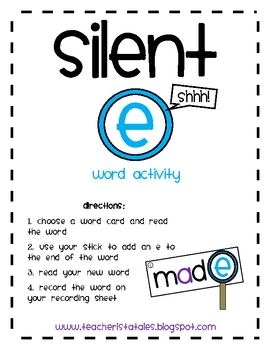
Mrs. Pollard, from Tales of a Teacherista, has a wonderful, wonderful  Silent E Word Activity FREE at her TPT store that I use and LOVE!

Silent E Word ActivitySilent E Word ActivitySilent E Word Activity
I made this anchor chart for the children-more plain and ugly much less cute and fancy than Susanna's, but with her idea. I started with two of the same words and no "e."  Then, during morning rug time when I introduced it, a child came up, glued on the Bossy "e," and said, "SAY  YOUR  NAME!" to the vowel before it.
  
During small group center time, we reviewed our lesson. We read both words across the paper and saw that without an "e" they were the same word.  Then, the children added a Bossy "e" to the left side list.


We highlighted the vowel, who would now say its own name, and then read the new words.  This really helped the children get the idea of what that "e" actually does.


Traci  has this great free worksheet at her blog.  You can stop over to her blog and get a copy!
Thank you, Traci! 

We reviewed the words from Mrs. Pollard's activity.  I laminated the papers, and just stuck the "e" on with putty.

We review some words each morning during our rug time, just to remember the short vowel sound without the "e" and then the long vowel sound with the magic "e." The children are doing really well.  Sometimes I have the girls do a word, then the boys; sometimes I have one child do a word; sometimes we all do it together.    JUST when I  thought we sort of "got it," (on the 3rd day of reviewing this) I said, "m-a-d... Here is my clue for that word," and I made a mad face.  The kids thought that was funny- and then I put the magic "e" at the end waiting for them to say "made" and... they said, "HAPPY!"  I just sort of stood there...  So... we keep practicing!


Whenever we have a few minutes between reading and writing, or after snack when I want to clean up the tables and get set up for centers, I have the children Chit-Chat with a friend on the rug (or in a group of 3 if needed). The children sit knee to knee with a friend and talk about our topic for the day.  Then, the other friend asks a question about what was said.  We practiced, and I modeled it with some of the kids. They know that they will be chit-chatting with different people each day- or nobody at all if they complain...so... They actually are really great about just sitting down with someone who is near them on the rug. 
Every day, we have a different Chit-Chat topic, and the kids love it! Some days they come into the room in the morning before school even starts and ask what we are chit-chatting about today. I guess they like to prepare.
An extension of this activity is when I ask one partner a question about what the other said.  For example, after we chit chat about favorite ice cream flavors, I might ask one partner to tell me what the other partner's favorite flavor was, to see if they were paying attention.  That keeps them on their toes and helps them realize that listening to friends is important.


If you would like a copy of my topics that I use, just click the picture below.  I print out a copy and leave it on my desk.  Then, I check off the one that we use.  I also use this as a writing prompt sometimes for morning work. 
https://drive.google.com/file/d/0Bw4BuVZdT_UxRU43b0xwMGJfTnM/edit?usp=sharing

  
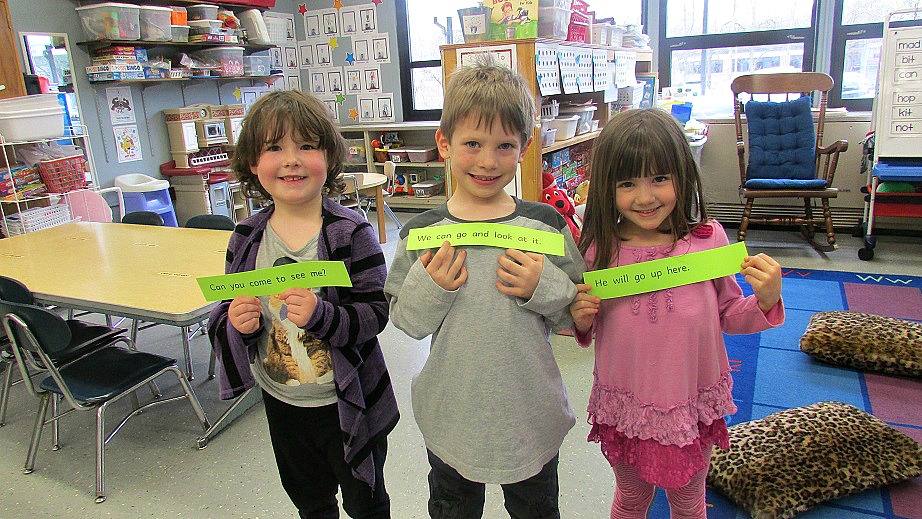
My kids have had so much fun reading sight word sentences. I call them FLASH sentences because they read them in a flash.  Sometimes during reading group, if we have a few minutes after a story, I will go around the table having each child read a sentence.  If they get it right, they get to keep it in their pile. 

If you would like a copy of these sentences, just click on the picture below.  They are SIMPLE.  I just copied them off on cardstock, cut them apart, and we use them all the time.  Sometimes I  pick one out as a sentence that I dictate that they have to write on the back of a morning work paper.
I posted HERE earlier in the week about some ideas I like to use for list writing with my class.  I love to find authentic ways to have the children write, so they see WHY it's important to know how to write neatly and to use as many sounds as they can in tricky words so they can read it and others can, too!


I found this post from Teachmama.com called What Not to Say to Emerging Readers a couple years ago, and I find myself thinking back to it often, so I thought I'd share it in case you haven't seen it. She gives you some good things to think about as you gently guide you students to read more and more. Here is the video of the post.  This would be really great to share with parents, too.
Here is the part that I am was guilty of saying sometimes...

I always felt like I was saying it positively and as encouragement, but I see exactly what she is saying in her article, and I am not going to say it anymore. (I catch myself!)
This is what Amy Mascott (the author) says:
  • DON’T SAY: You know this. . .
INSTEAD SAY: What part of the word do you recognize? If you get no response, say, Do you recognize this part (point to the beginning chunk or letter) or this part (point to the ending chunk or letter)?
Three things here:
1. If the kid knew it, she would have read it.
2. We all hate to be reminded that we knew something but forgot it.
3. By picking out two parts of the word, you’re setting her up for success. It all goes back to the choices thing that really helps with kids. Most likely she will recognize either the ‘b’ or ‘-at’ part of ‘bat’ or the ‘th’ or ‘-ick’ parts of ‘thick’.  If she can pick up either part, say, You got it! That does say ‘ick’. Now let’s put the first part, (give it to her and pronounce it) ‘th’ together with ‘ick’: th-ick. Thick!
Then put that new word into the sentence and give her a high-five for getting through it.
It is so good for me to think how I would feel if someone had been working with me on Physics or Chemistry (are you seeing a connection between me and a lack of science understanding?! yep.), and we had just gone over something, and I got to a question and had no idea how to do it.  I would NOT want to hear, "You KNOW this!" 

I remember taking a class where the teacher had our names written with symbols that we had to try to learn and recreate to "write" our names. It was hard! That was such a wonderful lesson to help put me in my little guys' shoes.

Thank you for stopping by.  Have a wonderful weekend!

Search This Blog